A neighbor of mine once set his timer to water his tomatoes for an hour every morning. His plants turned yellow and sad, and he was sure the drip system was broken. It wasn’t. His emitters were pushing out way more water than those tomatoes could ever use, and the roots were basically sitting in a swamp.
That’s the thing about drip. The number on your timer means almost nothing by itself. What matters is how many gallons land at each plant, and that depends on your emitters, not the clock.
So let’s talk about drip irrigation run time the right way: as a math problem you can solve in your head, not a mystery setting you fiddle with until the plants complain.
Key takeaways
- Run time depends on emitter flow rate (gallons per hour) and how many gallons a plant actually needs.
- Divide the gallons a plant needs by the emitter flow rate to get a starting run time in hours.
- Longer, less frequent watering builds deeper roots than short daily sprinkles.
- Treat your first number as a starting estimate, then adjust by checking the soil.
Start with your emitter flow rate
Every drip emitter has a rating printed on it or on the box: gallons per hour, or GPH. That’s the flow rate, and it’s the single most important number for figuring out run time.
Common emitters put out 0.5, 1, or 2 GPH. A 1 GPH emitter running for 30 minutes delivers half a gallon. Simple as that.
If you don’t know your flow rate, look at the emitter body. Most are color coded, and the box will tell you. If you’re still unsure how the parts fit together, my walk-through on drip irrigation for beginners lays out emitters, tubing, and fittings in plain language.
Good to know
Flow rate assumes your system is running at the pressure the emitter was designed for, usually around 10-30 psi. If your pressure is off, your actual output will be too, and your run-time math drifts.
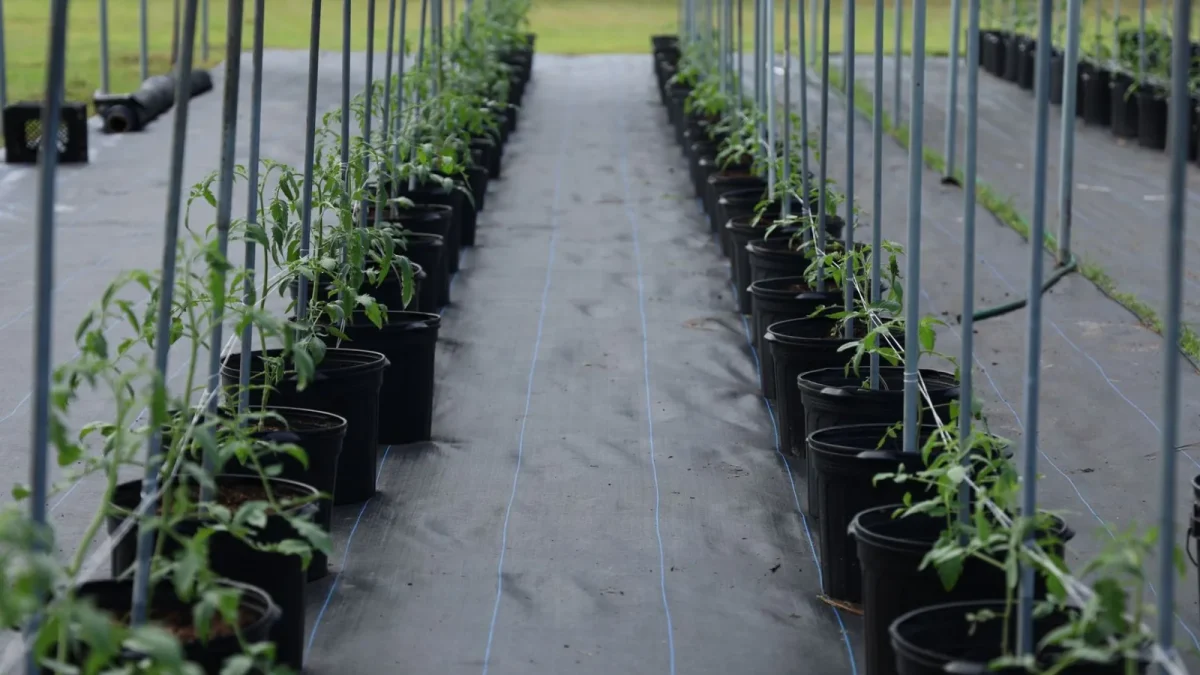
Figure out how many gallons each plant wants
This is where people freeze up, but you don’t need a soil lab. A rough gallons-per-day target gets you close enough to start.
Here are some real-world ballpark daily needs during warm growing weather:
| Plant | Rough daily water need |
|---|---|
| Tomato (mature) | 1 to 2 gallons |
| Pepper or eggplant | 0.5 to 1 gallon |
| Small shrub | 1 to 3 gallons |
| Young citrus tree | 5 to 10 gallons |
| Herbs or lettuce | 0.25 to 0.5 gallon |
These shift with heat, wind, and soil, so treat them as a starting point. For a more tailored number, I walk through the whole process in my guide on sizing water needs for each plant.
The one formula that ties it together
Here’s the whole idea in a single line: gallons needed, divided by emitter flow rate, equals run time in hours.
Say a mature tomato wants 1.5 gallons and you’ve got a single 1 GPH emitter on it. That’s 1.5 divided by 1, which is 1.5 hours of run time to deliver a day’s water.
Now swap in a 2 GPH emitter. Same 1.5 gallons, but now it’s 1.5 divided by 2, which is 0.75 hours, or about 45 minutes. Same plant, same water, half the run time. That’s why the timer number alone tells you nothing.
Quick tip
Put two emitters on a thirsty plant instead of one, and you cut the run time in half while spreading water more evenly around the root zone. Two 1 GPH emitters deliver 2 gallons in a single hour.
Walk through a real setup
Let me show you how I’d plan a small raised bed with six pepper plants.
- Each pepper wants roughly 0.75 gallon per day in summer.
- I put one 1 GPH emitter at each plant.
- Gallons needed (0.75) divided by flow rate (1 GPH) equals 0.75 hours, or about 45 minutes.
- Instead of 45 minutes every day, I’d run it about 90 minutes every other day to push water deeper.
Notice I didn’t water daily. Deeper, less frequent soaks pull roots downward, which makes plants tougher when the heat spikes. Short daily bursts keep roots shallow and needy.
Watch out
Long run times only help if the water soaks in instead of running off. In heavy clay, split a long cycle into two shorter ones (say two 20-minute runs an hour apart) so the soil can absorb it. This is called cycle and soak.
Pressure and tubing change the picture
Your formula assumes water actually reaches every emitter at full strength. If your pressure is too low, emitters at the far end of a long line dribble instead of drip, and those plants quietly go thirsty.
Most drip systems are happiest somewhere in the 15-30 psi range. Too high and you blow fittings apart; too low and flow rates fall short. If your numbers look right on paper but plants still struggle, check my primer on getting your drip pressure dialed in.
Tubing size matters too. A single 1/2 inch mainline can feed a lot of emitters, but 1/4 inch micro-tubing has limits. Overload a thin line and pressure drops before the water gets where it’s going. If you’re not sure what you’ve got, my rundown on choosing the right drip tubing covers it.
The EPA’s WaterSense watering tips are a solid reality check on how much water plants actually use through a season.
Check your work in the dirt
Math gets you a starting run time. The soil tells you if you nailed it.
A mistake I see constantly is people trusting the timer forever and never digging. Don’t be that person. After a watering cycle, poke a finger or a screwdriver into the soil near the plant.
- Moist 6 to 12 inches down: your run time is about right.
- Only the top inch is damp: run longer, or add an emitter.
- Soggy and standing water: cut the run time back.
- Bone dry an hour after watering: check for a clog or low pressure.
Do this check a couple times in the first week, then seasonally. As summer heats up, bump your run time. As fall cools down, pull it back. The formula doesn’t change, but the gallons your plants want will.
The University of Arizona Cooperative Extension has excellent regional watering publications if you want to fine-tune for your climate.
Where to go from here
Once you see run time as gallons needed divided by flow rate, the whole system stops feeling like guesswork. You can plan a new bed on paper before you buy a single emitter.
Start with a reasonable estimate, run it, then dig and adjust. Do that two or three times and you’ll have a run time that fits your plants, your soil, and your summer. That’s a system you can actually trust.
Frequently asked questions
How long should I run drip irrigation for a vegetable garden?
It depends on your emitter flow rate, not a fixed number. For a mature tomato needing about 1.5 gallons with a 1 GPH emitter, that is roughly 90 minutes. Divide the gallons each plant needs by the emitter's gallons-per-hour rating to get your starting run time, then check the soil and adjust.
Is it better to water longer and less often, or short and daily?
Longer and less often is usually better. Deep, infrequent soaks encourage roots to grow downward, which makes plants more resilient in heat. Short daily watering keeps roots shallow and thirsty. Aim to deliver a day or two of water in one longer cycle every other day rather than tiny sprinkles every morning.
How do I know my emitter's flow rate?
Check the emitter body or the original packaging, which lists gallons per hour (GPH). Most emitters are color coded, with common ratings of 0.5, 1, and 2 GPH. If you cannot tell, catch the drip in a measuring cup for a set time and multiply out to estimate the hourly rate.
Why is my drip run time working on paper but not in practice?
The most common cause is water pressure. If pressure is too low, emitters at the far end of the line put out less than their rated flow, so those plants get shortchanged. Clogged emitters and undersized tubing also throw off your numbers. Check pressure and inspect a few emitters before changing the timer.
Should I change my drip run time by season?
Yes. Plants use far more water in hot, dry weather than in cool months, so your run time should rise in summer and drop in fall and winter. The formula stays the same, but the gallons your plants need will shift. Recheck the soil moisture a few times each season and adjust.
What if the water just runs off before it soaks in?
Split a long watering into two or three shorter cycles spaced about an hour apart. This is called cycle and soak, and it lets heavy or compacted soil absorb water instead of pooling or running off. For example, run two 20-minute cycles instead of one 40-minute cycle.