Last summer a client in my Tucson neighborhood handed me two water bills side by side. One was from the year her raised beds ran on an oscillating sprinkler. The other was from the year after we switched those same beds to drip. The July numbers were almost 40 percent apart, and nothing else in her yard had changed.
That is the story most people want the answer to before they buy a single fitting. Not the theory, the gallons. So let me walk you through a sample home garden, do the arithmetic out loud, and show you where the drip irrigation water savings actually come from.
I will use round, honest numbers you can check against your own bed.
Key takeaways
- A sprinkler wastes roughly a third of its water to evaporation, wind drift, and overspray before it ever reaches a root.
- Our sample 200 square foot bed saved about 2,340 gallons over one 26 week season by switching to drip.
- Drip runs at roughly 90 percent efficiency versus about 65 percent for a typical home sprinkler.
- The parts for a small bed cost around 60 to 120 dollars, so many gardens pay that back in a season or two.
The sample garden we are measuring
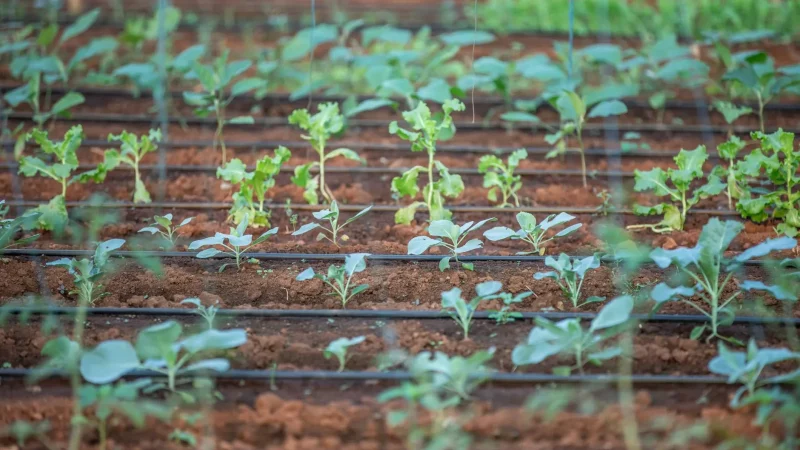
Picture a single raised bed, 4 feet by 50 feet, so 200 square feet of planted space. Tomatoes, peppers, basil, and a strip of marigolds along the edge. This is a real layout I install often.
Our season runs 26 weeks, roughly April through October here in the Southwest. Most vegetable beds want about 1 inch of water a week during that stretch, which is a standard figure you will see from most extension services.
One inch of water over 200 square feet is about 125 gallons of water that the plants actually need at the root zone. That is our fixed target. The whole question is how much water each method has to deliver to hit that 125 gallon goal.
What the sprinkler really costs
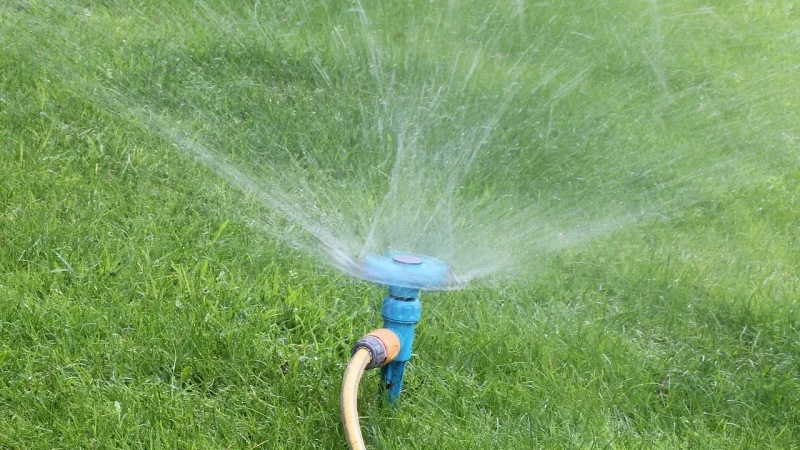
A home oscillating or pop-up sprinkler runs at roughly 65 percent efficiency. That word just means the share of water that reaches the plant instead of vanishing on the way.
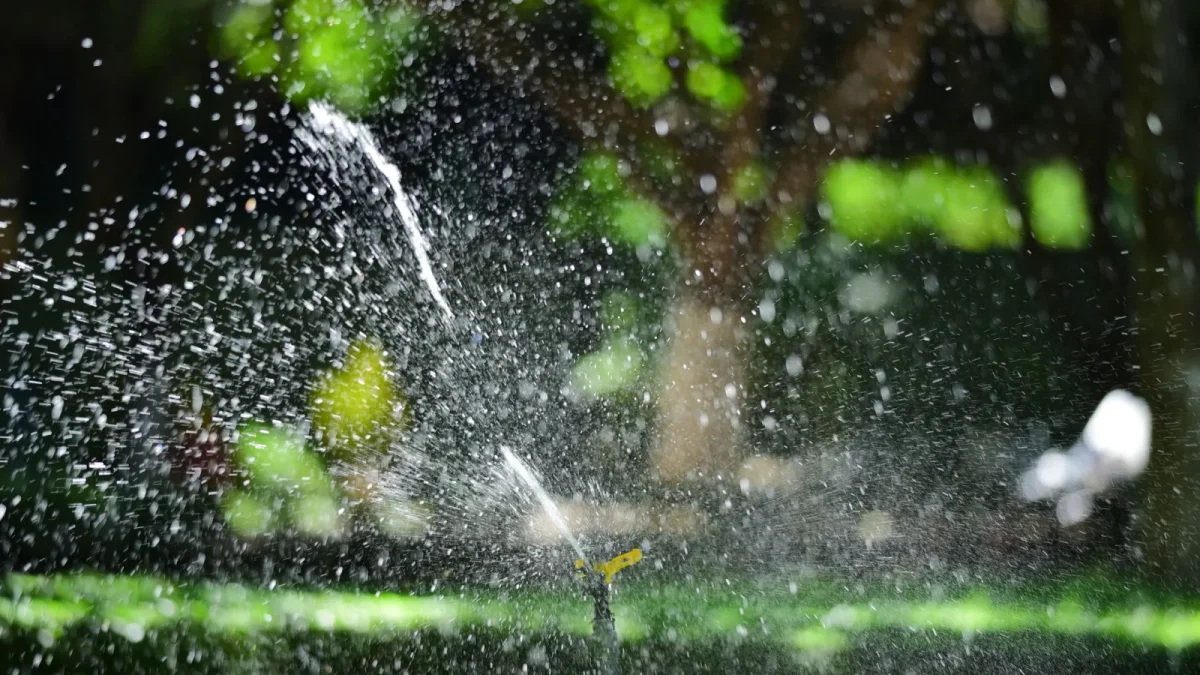
The other 35 percent leaves as evaporation off hot soil and leaves, wind drift that carries the spray sideways, and overspray landing on the path and the fence. In a Tucson July with 105 degree afternoons, that loss is not a rounding error. It is real water you paid for and never used.
To land 125 gallons at the roots at 65 percent efficiency, the sprinkler has to throw about 192 gallons a week. Over 26 weeks that is roughly 5,000 gallons for this one bed.
Watch out
Sprinklers waste the most water exactly when your plants need it most: hot, windy, midday conditions. Watering at 2 p.m. in July can push a sprinkler’s real efficiency well below 65 percent, so the gap in favor of drip gets wider, not smaller.
What the drip system costs
Drip irrigation delivers water slowly through emitters (small nozzles that let out a measured trickle) placed right at the base of each plant. Because that water goes straight into the soil, almost none evaporates and none blows away. Field data from the USDA puts drip application efficiency near 90 percent.
To hit the same 125 gallon root-zone target at 90 percent efficiency, drip only needs to deliver about 139 gallons a week. Over the 26 week season that is roughly 2,600 gallons.
So for one sample bed, over one season:
| Method | Efficiency | Water per week | Season total (26 weeks) |
|---|---|---|---|
| Sprinkler | ~65% | ~192 gallons | ~5,000 gallons |
| Drip | ~90% | ~139 gallons | ~2,600 gallons |
| Savings | – | ~53 gallons | ~2,340 gallons |
That is roughly a 47 percent reduction on this bed. It lines up with EPA WaterSense, which reports that drip and other microirrigation methods use 20 to 50 percent less water than conventional sprinklers, according to the agency’s EPA WaterSense microirrigation page.
Scaling up: what a whole yard saves
One bed saving 2,340 gallons is easy to shrug off. But most yards have more than one zone.
Stack a few beds, a row of shrubs, and some container pots, and the EPA figure for a typical home landing north of 25,000 gallons a year starts to feel very reachable. My client’s actual savings across her whole yard came in around 22,000 gallons in her first drip season.
Quick tip
To estimate your own savings, take your bed’s square footage, multiply by 0.62 to get gallons per inch of water, then compare 26 weeks of sprinkler delivery at 65 percent against drip at 90 percent. The formula is the same one I used above, just with your numbers.
Why the water disappears with a sprinkler
It helps to see the three leaks that drip closes off. Understanding this made drip click for me years ago, and it is the whole reason the gallons add up.
- Evaporation: spray droplets hang in hot, dry air and shrink before they land.
- Wind drift: a light breeze pushes fine spray onto the driveway and the neighbor’s fence.
- Overspray and runoff: a rectangular spray pattern never matches a rectangular bed, so the corners and edges get watered pavement instead of plants.
Drip sidesteps all three by putting water under the mulch, at soil level, one plant at a time. If you want the full mechanical picture, I broke it down in my walkthrough of how drip irrigation works, step by step.
The cost side of the savings
A mistake I see constantly is people assuming a drip conversion is expensive. For our 200 square foot sample bed, the parts list is short: a pressure regulator (drip runs best at 10-15 psi, far lower than a sprinkler), a filter, a length of 1/2 inch mainline tubing, some 1/4 inch feeder tubing, and a handful of emitters rated at 1 or 2 gallons per hour.
That kit runs about 60 to 120 dollars for a bed this size. If your water costs a few dollars per thousand gallons, the savings alone will not always cover it in one season, but the healthier plants and the hours you stop spending dragging hoses usually seal the deal.
Good to know
Pressure matters more than beginners expect. Send full house pressure (often 40-60 psi) into 1/4 inch drip tubing and you will pop fittings and blow emitters right off the line. A cheap pressure regulator is the fix.
A quick reality check before you switch
Drip is not magic. Emitters clog if you skip the filter, and a bed that is badly zoned can waste water in its own way. The two failures I repair most often both trace back to planning, not parts.
If you are starting from scratch, it is worth reading up on the beginner drip planning mistakes that quietly erase your savings, and getting familiar with the core drip system components so you buy the right pieces the first time.
Get the layout right and the numbers above are not optimistic. They are conservative.
Where to go from here
The takeaway from our sample garden is simple: for one ordinary bed, drip saved roughly 2,340 gallons in a single season while growing the same plants, and a full yard can easily save ten times that. The water goes to roots instead of the air.
If this is your first system, start with one bed, measure your own before-and-after bills, and let the results talk you into the next zone. When you are ready to plan it out properly, my beginner’s guide to drip irrigation basics will take you from an empty bed to a working line without the guesswork.
Frequently asked questions
How much water does drip irrigation save compared to a sprinkler?
For a typical home bed, drip uses roughly 20 to 50 percent less water than a sprinkler. In the sample 200 square foot garden above, that worked out to about 2,340 gallons saved over a 26 week season. The exact figure depends on your climate, wind, and how efficiently your sprinkler was running.
Why is drip irrigation more efficient than a sprinkler?
Drip delivers water slowly at soil level, right at each plant's roots, so almost none is lost. A sprinkler sprays into the air, where evaporation, wind drift, and overspray waste roughly a third of the water. That efficiency gap, about 90 percent for drip versus 65 percent for a sprinkler, is where the savings come from.
Does drip irrigation save money on my water bill?
Usually yes, though how much depends on your local water rates. If a bed saves a couple thousand gallons a season and you pay several dollars per thousand gallons, the savings add up over time. Bigger yards with several zones see the clearest bill reductions, often 25,000 gallons or more a year.
How much does it cost to convert one bed to drip?
For a small bed like the 200 square foot example, expect about 60 to 120 dollars in parts: tubing, emitters, a filter, and a pressure regulator. Larger or multi-zone yards cost more, but you can start with one bed and expand later. The parts are reusable and last several seasons with basic care.
Will drip give my plants enough water in a hot climate?
Yes, as long as you size the emitters and run time to your plants' needs. In hot regions like mine, drip actually delivers water more reliably than a sprinkler because none is lost to midday evaporation. You run it longer and slower, often early morning, so the soil soaks deeply instead of drying on the surface.
Can I run drip on the same schedule as my old sprinkler?
No, drip needs longer, less frequent runs. A sprinkler might run 15 minutes, but drip often runs 30 to 60 minutes to let water soak into the root zone. Start with your plants' weekly water need, then set a run time that delivers it slowly. Check the soil a few inches down after a run to confirm it reached the roots.